
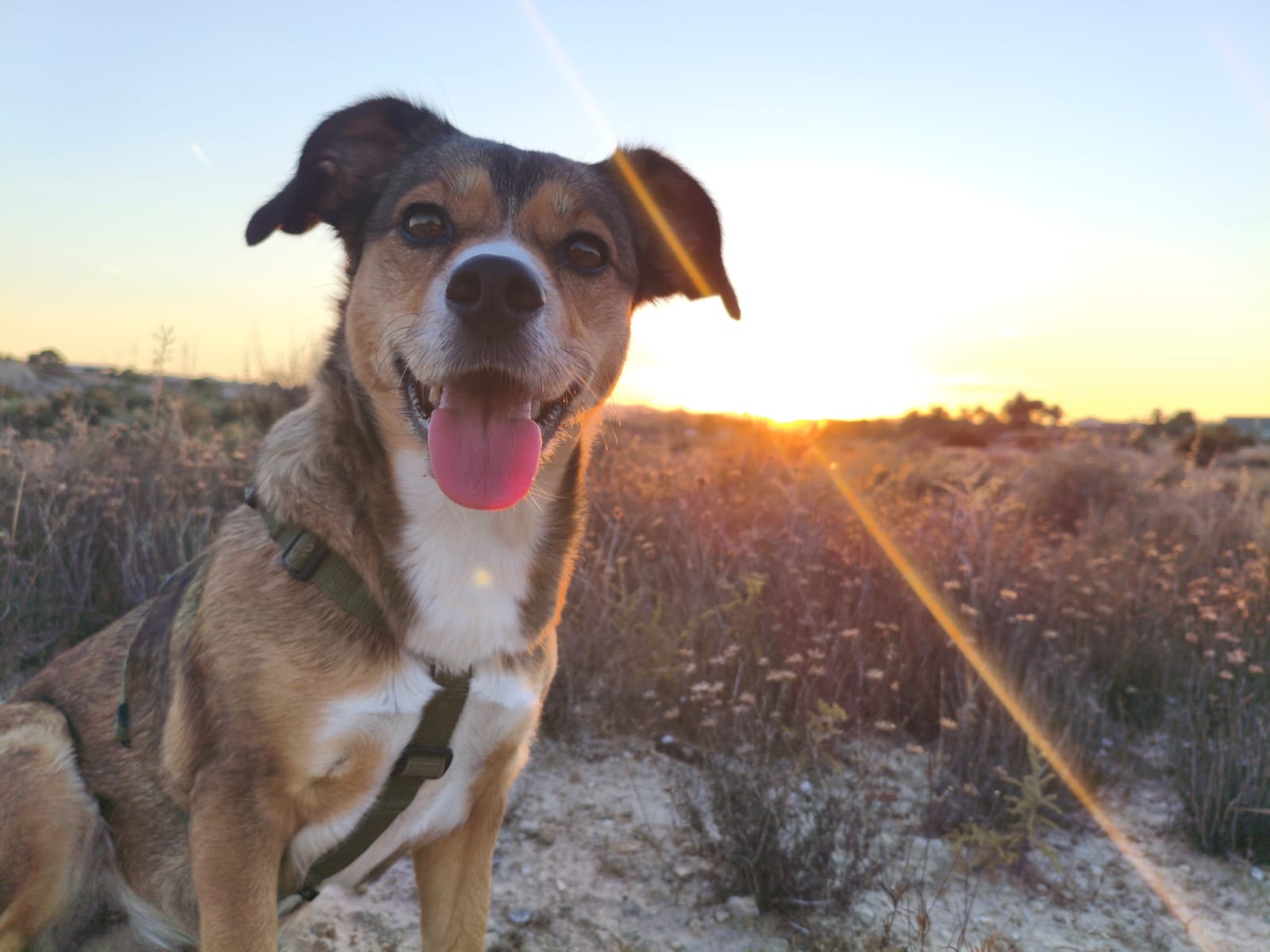
Do you really see YOUR dog?
Today I want to share a piece of thought that can hopefully serve you as some fertile ground for your own thoughts.
I have this question for you:
Do you think, there is a minimum requirement of self-reflection, that a human needs to bring to the table in order for a human-dog relationship to work?
I do. And chances are, you do too.
With self-reflection I mean: are we able to really see the dogs we have, or are we seeing the dogs we wish we had? And why would it matter anyway?
Really seeing the dog in front of us means being aware and mindful of your own wish-thinking and projections when it comes to the life you want with that dog.
Maybe you got them thinking that you can take them everywhere. Maybe you are into sports and wanted a companion that joins you on long runs or hikes. Maybe you already had a lot of dogs in your life and think you have seen it all.
Whatever it is, from the moment we commit to a life with a dog, every single one of us has ideas about how this future life is going to be. How we want it to be.
And don’t get me wrong: I am not saying that you should not work towards those goals.
What I am saying is:
Be honest with yourself if you find your dog struggling with those situations that you repeatedly want them to participate in.
Let’s say you want your dog to be able to join you in cafés and bars and other social gatherings. But your dog shows some reactivity to people and maybe even other dogs.
So each time you take your dog into these settings, something happens, and your dog reacts. Sometimes more, sometimes less. The tricky thing is that they are not totally out of control. Nor do they lose it each and every time. But more often than not, a lot of management is necessary so that the situation doesn’t escalate further.
And because it sometimes seems to be ok, each time, you come up with a reason why your dog reacted, and think that if you are more mindful of this or that detail, your dog is going to be fine.
They just need to have more exposure to those things and get used to them.
Does it sound familiar?
I am not saying this to blame anyone. I think we have all been there. I definitely have.
But if you understand some of the basic mechanisms of learning and stress, you also understand why repeating an experience is not necessarily going to teach your dog to cope with it.
So instead of blaming your dog, the circumstances, or yourself, you can just ask yourself:
Has my dog consistently shown the skills needed to cope with this situation?
And if the answer to that is “No”, this is fine. You are now free to grieve that the life you imagined with your dog is not the life you ended up having.
The interesting thing is: grief does not mean that you give up on them, or your goals. Instead, it opens your eyes.
You finally start seeing the dog that is actually in front of you.
By acknowledging where you are in your journey, you are now finally able to take the first step towards progress.
To start where you actually need to start.
Everything that you might have done before that was not necessarily wrong, but it might have been step 5 or 10 or 20 down the line.
And it couldn’t have worked because you needed to start at step 1.
And I think this question is just as important for professionals as it is for guardians. Instead of focusing directly on the behavior we would like to modify, we should rather look at the foundations that lead to it. The coping skills that might be missing.
Seeing the dog for who they currently are, without judgement and fatalism, is what allows us to actually start supporting them. And it also helps us see and celebrate all the small wins along the way.
This is one of the ideas we explore in The Adolescent Dog Brain Course, alongside the developmental and neurobiological changes that lead to “typical” adolescent behaviors. The course is launching soon if you’d like to dive deeper.